
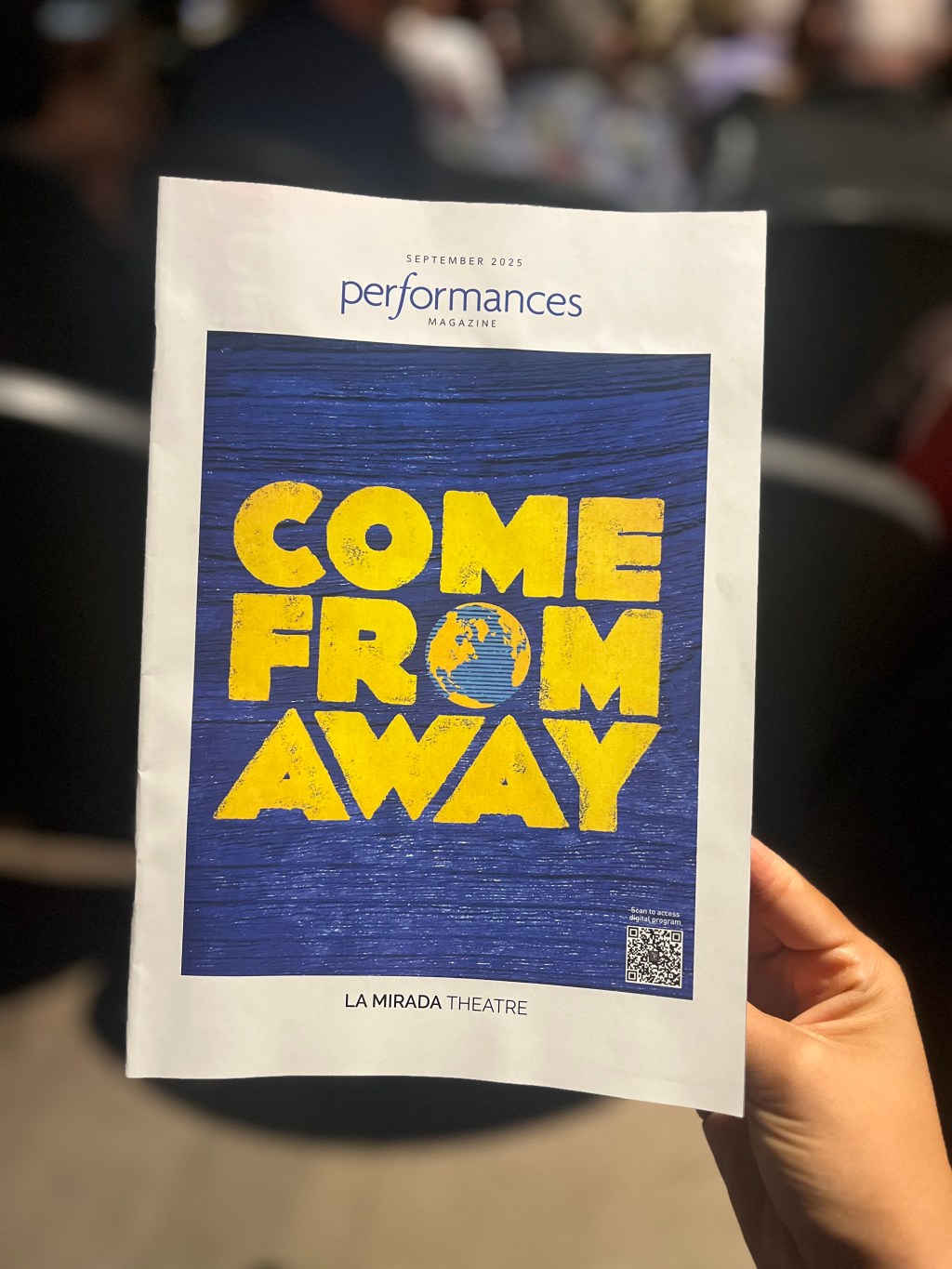
Come From Away
McCoy Rigby Entertainment / La Mirada Theatre
Director: Richard J. Hinds
Music Director: Sam Groisser
Choreography: Richard J. Hinds
Run Time: 100 Minutes (No Intermission)
Review & Photo Credits by Destiny Lynn
Hope in the Wake of Uncertainty
On Tuesday, September 11, 2001, the world paused. Planes were grounded, skies fell silent, and questions filled the air: Was this an accident? Was the United States under attack? What will happen next?
Thousands of flights were diverted to new destinations, one of which was Gander, Newfoundland, a small Canadian town that suddenly doubled their population overnight. Come From Away traveled to La Mirada Theatre for the first time to reveal the story of what unfolded the week after September 11, 2001 when fear and compassion collided. It was a musical grounded from real interviews with those who lived through it: The “plane people” stranded far from home and the Newfoundlander people who opened their town to the visitors. Commonly referred to at the September 12 Musical, Come From Away was not a documentary; however, it captured the emotional truth of those days with warmth, humor, and a kind of hope that feels especially needed right now.
Twelve Actors, Over Sixty Roles
One of the things that made Come From Away so special was its structure: twelve actors who shared more than sixty roles. Each actor moved seamlessly between townsfolk, traveler, and crew making each member a lead and an ensemble. Because there were no traditional leads, the performance echoed a collective voice to remind us that everyone’s story mattered.
However, Misty Cotton who played the pilot Beverley Bass among her many roles delivered some of the show’s most powerful moments. Her solo “Me and the Sky,” cut through the music like a clear beam of memory that felt personal, brave, and beautifully sung. The story regarding how the pilot and flight attendants responded further echoed an important perspective often left in the background. However, the entire cast deserved credit for keeping up the show’s near continuous flow of music and choreography. With almost no dialogue breaks, the actors shifted characters, dialects, and emotions on cue. Every member even played multiple instruments on stage.
Under music director Sam Groisser, each cast member performed custom solo passages that he developed for this production alongside the traditional score. This meant the cast needed to perform their lines or solo on cue as the music continued to the next verse or else they would miss their moment. As an added pressure, the lines often branched off from one another, requiring careful coordination between the actors and sound design. Despite some minor delays in making sure the actors’ mic were turned on/off in time, the timing was largely impressive. As a result, Grossier’s ability to blend storytelling and musicianship made the performance feel truly local and handcrafted to his team’s ability.
A Familiar Story, Newly Staged
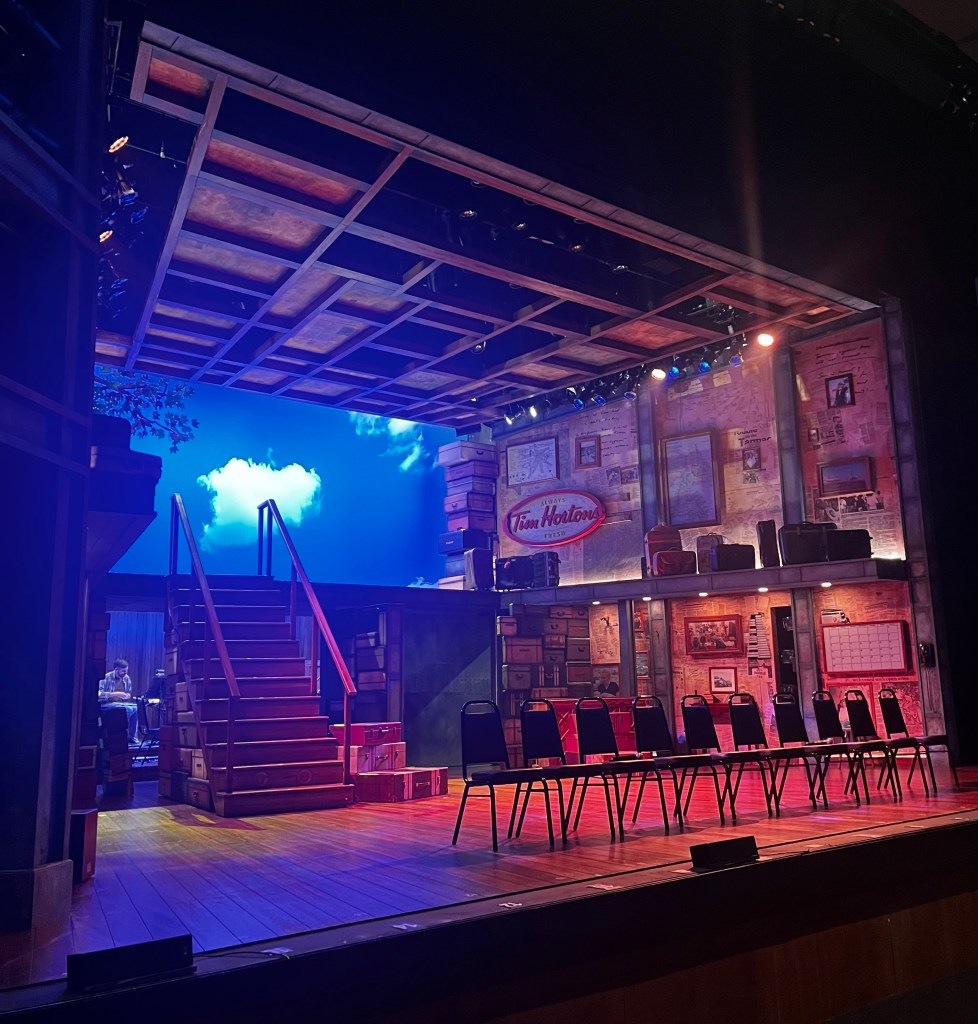
Even prior to hearing the performers, the stage itself was a piece of artwork that was multifunctional in subtle ways. Director and Choreographer, Richard J. Hinds was part of the original Broadway creative team but delivered a new direction. Working with scenic designer, Nate Bertone, Hinds traded the minimalism of the Broadway set for a design that was practical and poetic. Instead of a largely blank stage with real trees sprouting, Bertone designed a new stage to encompass the town of Gander. The central staircase became a bus. Windows turned into TV monitors. Chairs transformed into airplane seats. Finally, coat hooks doubled as quick change stations for costumes and instruments making every transition move in harmony with the story’s heartbeat.
Finding Hope During Uncertainty
At its heart, Come From Away was not a story about tragedy. It was a story of what people do after tragedy. Of all places for planes to land, why Newfoundland, Canada? A convenient location previously used for refill planes? A small population away from a major city for fear of a larger attack? The people of Gander did not know who was arriving or how long they would stay. Nonetheless, they showed up for strangers when the world felt like it was falling apart. They cooked, comforted, and cared for thousands by putting their lives on hold and setting their own state of emergency. They even turned a hockey rink into a massive refrigerator and their homes into shelters to make the 7000 “plane people” more comfortable. Without asking for anything in return, the story presented a powerful reminder that generosity and compassion could exist from strangers from diverse backgrounds.
The show did not shy away from the fear or suspicion that surfaced in the aftermath from the “plane people.” Unfortunate consequences surfaced from fear such as trying to define who the enemy was or who to trust. However, the collective attitudes to persevere took center stage and reminded us that kindness could spread just as quickly as fear. That is what gave this story its arc.
It is not a surprise that this production literally had audience members on the edge of their seats. Those alive to consciously remember each had a distinct memory of what they were doing on September 11, 2001. As the audience watched, you could hear soft gasps, quiet sniffles, and even laughter, the kind that came from recognizing a shared humanity. By the time the company reached their final number, the applause felt less like a routine theater etiquette and more like a gratitude because their was one story each could relate to: Someone they knew on the planes, someone they knew in the towers, waiting to hear from a loved one, or waiting to see what would unfold over the next hour, day, week, or years.
Therefore, how do you write, or sing, about a tragedy like 9/11 without opening old wounds? Come From Away found the answer by celebrating what came after from Gander: the generosity, resilience, and sense of community that reminded us who we could be. By carefully interviewing those affected and retelling experiences in our collective memory, Come From Away delivered the painful and resilient memories by making the different perspectives the heart of the story. The show revealed a strong reminder for a divided world that a global community could exist.
It was no wonder the show has become one of the most produced musicals in the country this season. La Mirada’s production captured everything that made the original special, while adding a few new reasons to fall in love with it again.
There is still a chance to see Come From Away before it closes this weekend. And if you have, you might find, like I did, that it is a story worth revisiting not for the sadness it recalls, but for the hope it renews.
Further Recommendations:
2017. Come From Away: Soundtrack. Spotify.
2019. Come From Away: Welcome to the Rock: An Inside Look at the Hit Musical. Amazon.
2025. Come From Away Will Be the Most Produced Show in the US. New York Times.
Destiny Lynn is a writer and reviewer with a passion for exploring the intersection of history, identity, and storytelling through musical theatre and novels adapted to screen.
 Book-in-Motion
You must be logged in to post a comment.