
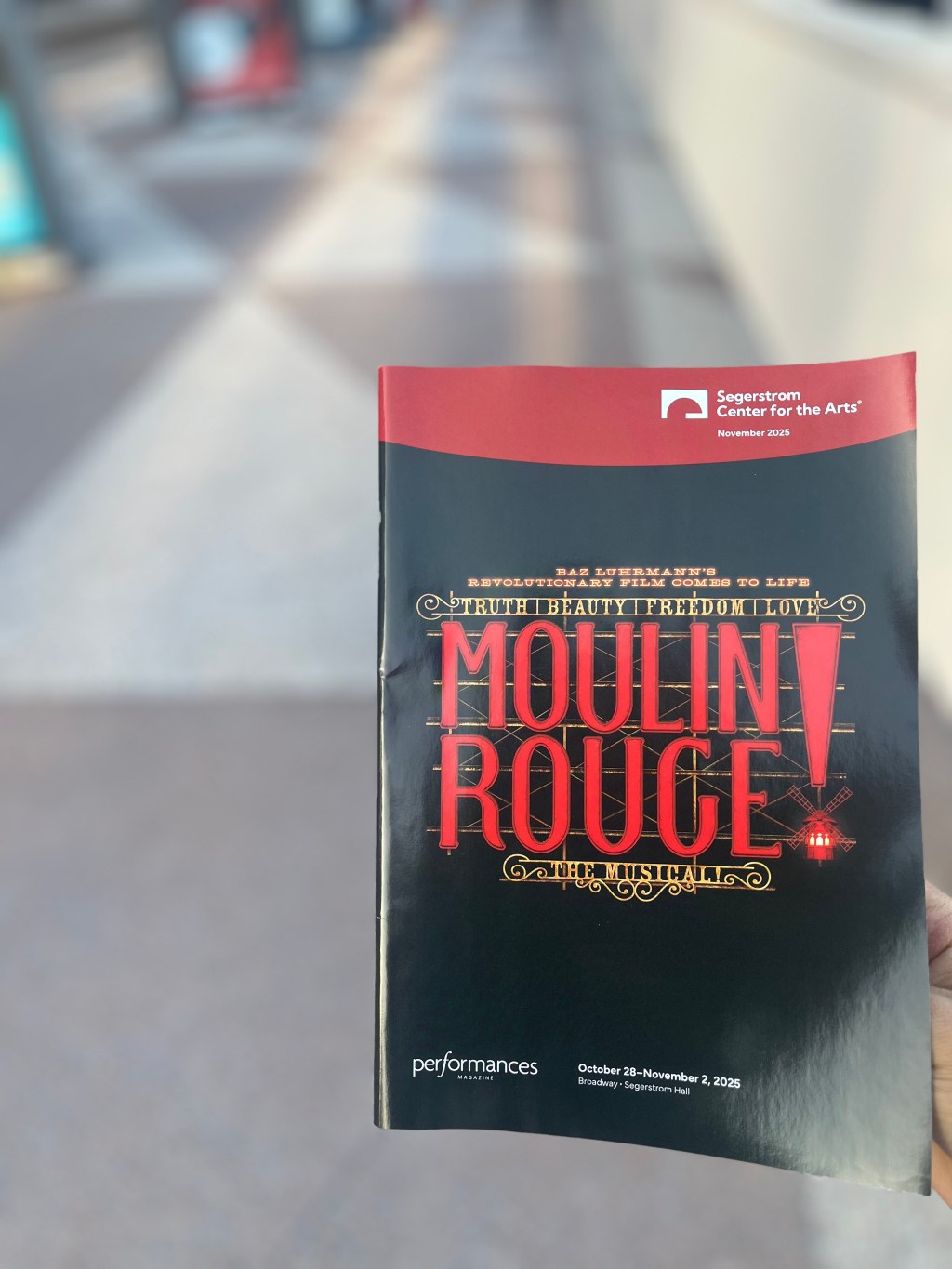
Moulin Rouge! The Musical
North American Tour / Segerstrom Center for the Arts
Director: Alex Timbers
Choreographer: Sonya Tayeh
Run Time: 2 Hours and 38 Minutes (+ 18 Minute Intermission)
Review by Destiny Lynn
A Remake of Baz Luhrmann’s 2001 Film
How far can love transcend, especially when life demands certainty? For one week, Segerstrom Center for the Arts invited audiences back into the velvet-drenched world of Moulin Rouge: The Musical. Following their 2021 Tony Award success for best musical, Director Alex Timbers continued to extend Baz Luhrmann’s 2001 film into a high-voltage stage experience.
Set in 1899 and inspired by the real Moulin Rouge Theatre, the story followed Christian, a young songwriter, to Paris. Searching for purpose, Christian tumbled into a doomed love triangle with Satine, the star of the Moulin Rouge, and the controlling Duke of Monroth. Between the absinthe-soaked visions, the bohemian ideals, and the constant threat of financial collapse, the show framed its romance in the language of four values: Truth, Beauty, Freedom, and Love, told through compilations of pop and rock music.
Understudies Unite!
In the event where both leads are absent, which was the case on the evening I attended, understudies readily fill the role on a moment’s notice. As a result, John Cardoza (Christian) and Jerica Exum (Satine) filled in and sustained the level of talent demanded by a lead role.
However, John Cardoza was no stranger to the role of Christian. Taking over in the original Broadway production after Aaron Tveit’s departure, Cardoza returned to deliver the same energy and talent. His standout moment arrived in Act Two’s absinthe scene, where he balanced hallucination with precision, slurring just enough to stay in character without sacrificing musicality.
Meanwhile, Jerica Exum was the night’s biggest surprise in creating a memorable performance as Satine. With a comparatively shorter professional resume, she met the demands of the role with quiet intensity. Her performance gained power in the intimate beats leading to Satine’s final moments, where she held both sides of the character: the lover fighting for happiness and the woman trapped by circumstance.
A Compilation Mixtape
Before dreams and love were chased, Alex Timbers opted for a “soft opening” by having the performers on stage prior to the start. Those familiar with & Juliet, would notice a similar opening that had the performers in choreographed stretches prior to the start of the show. While visually playful, it also blurred the line between observing backstage life and when the story started. Hence, it contributed to some confusion at both the opening and closing moments.
The heart of the production, though, was Tony award winner Justin Levine’s musical architecture. His musical arrangements weaved together a compilation of contemporary pop and rock that transformed familiar songs into emotional cues for this Jukebox Musical. Similar to Baz Luhrmann’s 2001 film, Levine extracted excerpts from popular tunes for the musical. Instead of isolating each number, Levine grouped them by theme: the opening “Welcome to Moulin Rouge,” the glittering “Sparkling Diamond,” and the sinister “Sympathy for the Duke.” These clusters built momentum and carried transitions with ease. The only drawback was sound mixing that overshadowed vocals, but the craftsmanship of the arrangements still rang through.
Designs L’Amour
In addition to the impressive arrangement of songs, the set designs were a magnificent, psychedelic work of art. Walking into the auditorium was like stepping into a Parisian dream soaked in neon: oversized hearts, layered textures, and the iconic elephant tucked into the designs. Satine’s room glowed with the Eiffel Tower lights, a small universe in golds and reds. The Paris streets, introduced when Christian first arrived, brought a rustic detail that grounded the story and balanced the more extravagant moments. With the bright, neon lights and 3-D design effects, the stage combined cabaret and burlesque to create a lively form of entertainment wrapped in an intimate, teasing setting.
The Four Tenets Alive on Stage: Truth, Beauty, Freedom, Love
Despite dedicating a song to “Truth, Beauty, Freedom, and Love,” these themes were embedded in the show’s DNA. Whether through the beauty of Paris or the short-lived, encompassing love story between Christian and Satine, Moulin Rouge: The Musical fused beauty and love through the narrative, set pieces, and musical arrangements. Even though the musical took creative inspiration from the actual Moulin Rouge Theatre in Paris, Timbers preserved the venue’s color-scheme, design, and wardrobe that differentiated the working and wealthy classes. This integrity also found its way into the narrative through some french accents from Jahi Kearse as Toulouse-Lautrec. Finally, freedom to live and choose was interspersed. Tension between the Duke and Toulouse-Lautrec revealed class tensions, while Satine’s tension to free herself from her social status or love freely was evident. Of course, there was always absinthe that temporarily freed Christian from short-term heartbreak.
The night I attended was nearly sold out, with many in the audience dressed to match the occasion. Despite pacing quirks, the response was overwhelming positive.
Ultimately, Moulin Rouge: The Musical didn’t reinvent the idea of a tragic romance. Instead, it delivered it with contemporary sparkle that was familiar and new. Fans of & Juliet or Jukebox Musicals in general would find plenty to love in the mashups, spectacle, and emotional sweep of Moulin Rouge: The Musical.
If you missed the brief run at Segerstrom Center of the Arts, there is still good news: Moulin Rouge: The Musical travels to the Pantages Theatre in Los Angeles from November 4-16 before heading to Washington State. Don’t miss your chance to see your favorite hits fused into a Tony winning French Musical!
Destiny Lynn is a writer and reviewer with a passion for exploring the intersection of history, identity, and storytelling through musical theatre and novels adapted to screen.
 Book-in-Motion