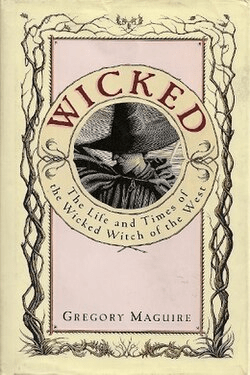
Wicked by Gregory Maguire
Written: 1995 | Adapted: 2024
Pages: 456 | Format: Paperback
Genre: Literature, Fantasy, Parallel Fiction
Price: $16.99 Kindle | $19.99 Paperback
Overall Rating (3/5)
Quick Takeaways:
Gregory Maguire’s Wicked reimagined the classic tale of The Wizard of Oz with a unique twist: a tale surrounding the antagonist known as the “Wicked Witch of the West” or Elphaba for short. Reimagined through book, Broadway, and film, Director Jon M. Chu finally brought this adaptation to screen with an unlikely, diverse cast that moved more than the book.
🌟Not Your Broadway Musical Wicked
Take away the music and magic, and you are left with a heavy, politically and religiously charged prelude to The Wizard of Oz.
🌟Elphaba: Villain or Tragic Hero?
Born green and branded as “wicked,” she spent her life resisting injustice but could never outrun her label.
🌟Oz: Terribly Good or Bad?
Maguire’s Emerald City glittered with poverty and a Wizard who built a regime through propaganda, secret police, and oppression.
🌟 Dr. Dillomond: Animal or animal?
Once a respected professor, Dr. Dillomond experienced the novel’s main theme of the cost of stripping away rights.
🌟Dorothy: Savior or Murderer?
She doesn’t take up much space in the book, but her role raised many questions: was she a savior, or simply another tool of power?
Scroll down for the full review and Book-to-Screen comparison.
Wicked: Gregory Maguire’s Novel & Its Film Adaptation
Written: 1995 | Adapted: 2024
Pages: 456 | Runtime: 2 Hours 40 Minutes
Genre: Literature, Fantasy, Parallel Fiction
Read/Watch Order: I watched the film, then read the book. The plot differs drastically; many may prefer the film without the book.
Book Review
“In the life of a Witch, there is no after…there is no happily.” From its closing lines, Gregory Maguire’s Wicked: The Life and Times of the Wicked Witch of the West made one thing clear: this was not L. Frank Baum’s children’s tale of the Wizard of Oz. Written nearly a century after The Wizard of Oz, Maguire reimagined the Wicked Witch not as a caricature, but as Elphaba–born green and destined to be branded as “wicked” before she ever took flight. A complicated, intelligent, and ultimately tragic figure, this new story actively questioned what it meant to be evil.
Divided into five parts, Gregory Maguire loosely aligned with The Wizard of Oz by focusing on Elphaba’s strange childhood, her time at Shiz University, and then into adulthood. Along the way, we saw a fractured Land of Oz: Emerald City at the center of power, Munchkinland as its breadbasket in the east, the desert Vinkus in the west, the northern Gillikin area where Shiz University resided, and the marginalized Quadling County in the south. Interspersed was the briefly mentioned Yellow Brick Road. Each land reflected a different social divide, all under the Wizard’s tightening control.
However, the book was disjointed when moving from one part to the next, despite staying in chronological order. The narrative was dense, filled with long descriptions and detours that sporadically stalled the plot. It almost forced the reader to jump from one scene to the next without detailing how or why a situation came about. Still, the fragments come together to answer a larger question: What made someone wicked? Was it their actions, their difference, or the way others chose to define them? Even the Wizard of Oz himself determined Elphaba as a “caricature of a witch.”
Admirably, Maguire did not shy away from weighty themes. Religion, inequality, propaganda, and the silencing of dissent were integral to the story. Animals – those who could speak and reason – were stripped of their rights and forced back into silence. Meanwhile, Elphaba, marked green at birth, fought against being dismissed and categorized. Her sister, Nessarose, became the Wicked Witch of the East, twisted not by her difference but by her faith.
That was where Wicked succeeded. It did not redeem the Wicked Witch; it complicated her. But that complexity came at a cost. The book was heavy, grim, and often challenging to love. Readers looking for the Broadway spectacle will be disappointed. However, those who enjoy layered political allegories will find plenty to unpack. As such, Wicked reads much like a literature book appropriate for young adults who do not mind diving into detailed imagery and religious allegories to see how the Wicked Witch of the East (Nessarose) and the Wicked Witch of the West (Elphaba) emerged in that reputation alongside other leading characters.
Wicked was ambitious, provocative, and dark. It was a challenging read with flashes of brilliance, but a pacing problem that kept me from fully connecting. That is why I landed at 3 out of 5 stars.
Novel Rating (3 / 5)
Film Adaptation Review (Part 1)
If the book was about the politics of evil, the film served as the spectacle of redemption and the power of friendship. While the book examined Oz through a harsh, sociopolitical lens, the film reframes the same world as a stage for personal growth.
Before there was Dorothy and the Yellow Brick Road, there was Elphaba and Glinda. Part One centered on their formative years at Shiz University, drawing more from the 2003 Broadway musical than Maguire’s original novel. Familiar songs guided the narrative, allowing audiences to witness how two opposing personalities formed a bond amid class expectations, social labels, and competing visions of what constituted “goodness.” The adaptation highlighted how the world decided who was an outcast and ultimately wicked long before Elphaba claimed the name. Meanwhile, emphasis on Glinda’s character development in the film further explained how her path ultimately led her to become the Good Witch.
Performance & Casting:
Director Jon M. Chu combined the spectacle of what film and Broadway could do. By casting members who were not strangers to Broadway, this made the film an extension of the stage rather than a typical movie musical. Cynthia Erivo delivered an Elphaba who blended vulnerability with conviction. She was an outsider who questioned injustice even as she yearned to belong. Her vocal performance was extraordinary by revealing her range to belt high notes from “Defying Gravity” and emotional restraint in quieter scenes. “The Wizard and I” became less about ambition and more about longing for acceptance on her own terms. Heck, she even performed her own stunts, echoing someone used to making the magic happen from her time on stage.
While initially hesitant towards Chu’s selection for Glinda, Ariana Grande was a standout surprise by delivering a role drastically different from the identity she built her fame on. Grande abandoned her pop persona that younger generations gravitated towards and revealed a character shaped by privilege, performance, and genuine conflict. Her Glinda was not simply bubbly; she was aspirational, insecure, and ultimately responsible for constructing her own reputation. Grande’s ability to merge comedy with sincerity made Glinda’s growth feel earned.
Supporting performances strengthened the world rather than distracted from it. Marissa Bode’s Nessarose offered a grounded portrayal that tied disability and the power of identity in a way the stage version had not done. Bode surprisingly made history as the first person to play Nessarose, who was wheelchair-bound. However, she delivered Nessarose in an authentic representation by not having to envision the struggles her character experienced. Meanwhile, Jonathan Bailey’s Fiyero brought charisma, while Michelle Yeoh, Ethan Slater, Bowen Yang, and Jeff Goldblum contributed nuanced layers to an Oz defined by image and illusion.
However, fans of the original Broadway production would have appreciated Chu’s efforts to include originals, Idina Menzel and Kristin Chenoweth, back home to Oz. Instead of reprising their roles as Ephaba and Glinda, they passed the torch to Cynthia Erivo and Ariana Grande. Unexpected and wonderfully surprised, “One Short Day’s” extension allowed Menzel and Chenoweth to narrate the story of Oz through song to support a nostalgic sequence. As a story about redemption and friendship that comes full circle, Jon M. Chu did not hold back on the details.
Visuals, Sound, Mood:
Many renditions have been made about the story of Oz on page, stage, and screen that made a significant impact for its time. The Wizard of Oz made Technicolor popular for motion pictures. The Broadway musical made flying an innovative feature on stage. Even Oz the Great and Powerful revealed the beauty of Disney film-making.
Chu embraced the film’s capacity for scale by demonstrating the power of cinematography. Shiz University and the Emerald City felt lived-in and visually cohesive without overwhelming character moments. While some of the Wizard’s illusions veered towards Marvel-style spectacles, the visuals reinforced the idea that Oz was built on smoke and performance.
One of the film’s most artistic choices resided in its use to display the layout of Oz. “A Sentimental Man” became a testimony of Oz the man and Oz the land. Through miniature landscapes and glowing pathways illuminated by the Yellow Brick Road, the visuals transformed an unpopular song into a visual echo of a new world order shaped by man.
Overall, the film prioritized emotional accessibility over political density, resulting in a Part One that was both epic and intimate for diverse audiences.
Film Rating (4.5/5)
Page to Screen
Faithfulness to the Source: Measured against Maguire’s novel, the film was a loose adaptation at best. But when evaluated alongside the Broadway production, its fidelity was much stronger. Despite following Elphaba’s chronological life to reveal how she became “wicked,” Chu’s version followed the musical’s narrative architecture. Themes such as friendship, betrayal, and self-discovery were amplified for a modern audience. The film, albeit much longer than the Broadway performance, moved the story for the audience and emphasized why she was portrayed as evil.
Where the Adaptation Departed: The most significant departure from the book was the tone. Maguire’s Wicked was a layered political allegory about propaganda, religion, and moral ambiguity. The film simplified these elements in favor of emotional clarity and a more universal story of belonging. Elphaba’s activism became less about systems of oppression and more about personal integrity. Glinda’s rise became less about political complicity and more about self-deception and image management.
What was Lost; What was Gained:
Lost:
- The intense political and religious commentary that defined Maguire’s Oz
- Elphaba’s fragmented, psychologically heavy developmental arc
- The morally ambiguous worldbuilding that left readers questioning every institution
Gained:
- A story centered on identity, empathy, and chosen family
- Two female leads whose emotional journeys informed one another
- A clearer sense of narrative momentum and thematic accessibility
- Musical storytelling that deepened character motivations rather than softened them
Importantly, the film did not attempt to “fix” the book; it interpreted it for a different cultural moment. Today’s audience gravitates towards stories that reaffirm selfhood rather than interrogate suffering. In this way, Wicked’s adaptation became a reflection of its times, just as Maguire’s novel reflected the political anxieties of the mid-1990s.
With Part Two still to come on November 21, 2025, the question remains whether Chu will include elements from Elphaba’s childhood and the darker corners of Maguire’s Oz or whether the musical framework will continue to lead.
Adaptation Fidelity Rating (1/5): Book
And That’s a Wrap
If you admired the Broadway or Film version for its music and heart, the novel may feel like its grim, intellectual cousin. Gregory Maguire’s Wicked was ambitious, political, and dark — sometimes too dark for its own good. At 456 pages, the prose could feel dense, but the payoff was a reimagining that forced you to question what ‘evil’ really entailed. For fans the Broadway musical, the book may shock you with how grim it felt. For readers who enjoy a slow-burning, allegorical fantasy, it is a rewarding challenge. For everyone else, the film or stage version might intrigue you more.
Reader’s Note: If you have experienced reading the series, watching on Broadway, or viewing in theaters, which adaptation resonated with you?
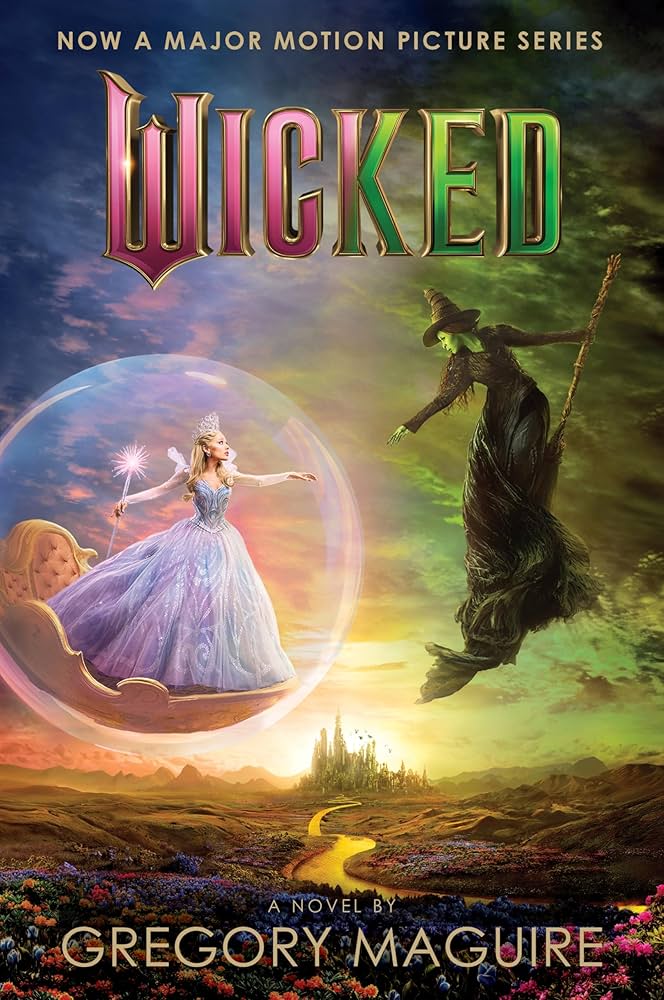
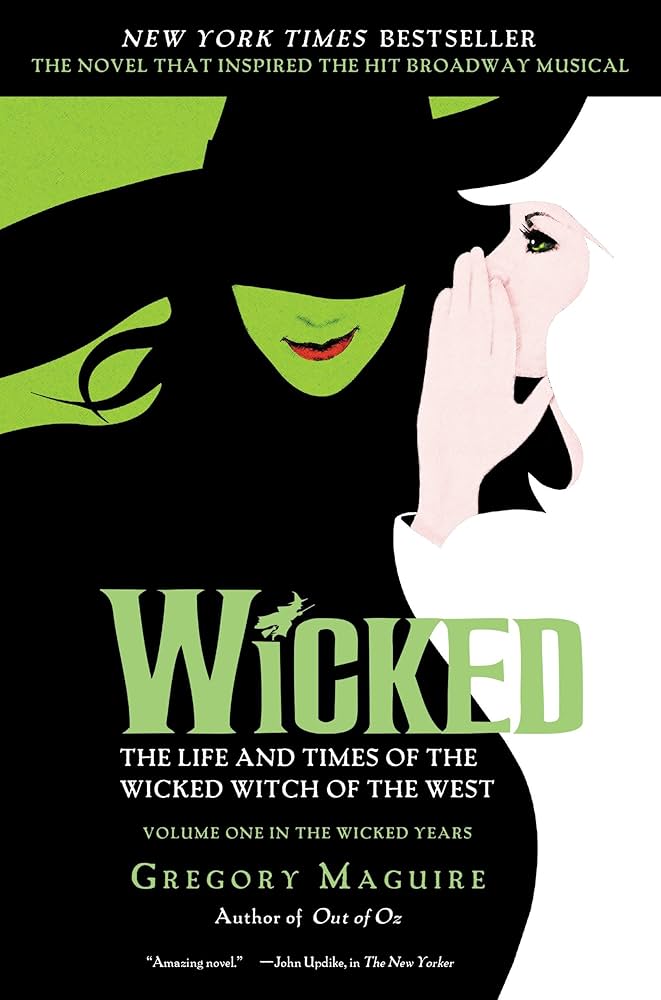
Gregory Maguire, Wicked, Amazon. (Book: 1995 Cover)
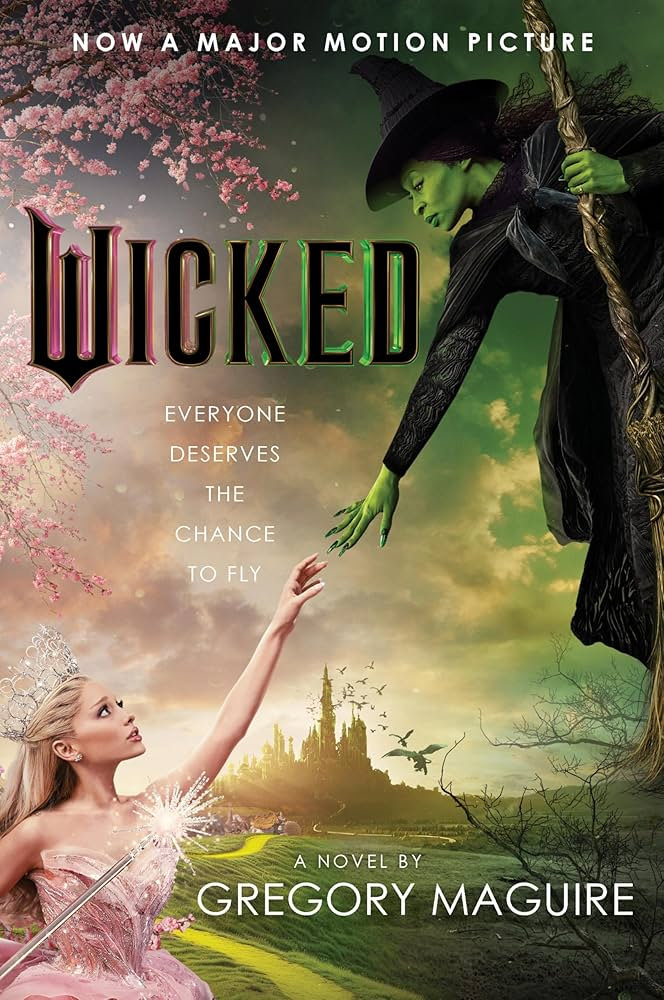
Gregory Maguire, Wicked, Amazon. (Book: Movie-Tie-In)
Destiny Lynn is a writer and reviewer with a passion for exploring the intersection of history, identity, and storytelling through musical theatre and novels adapted to screen.
 Book-in-Motion
You must be logged in to post a comment.