
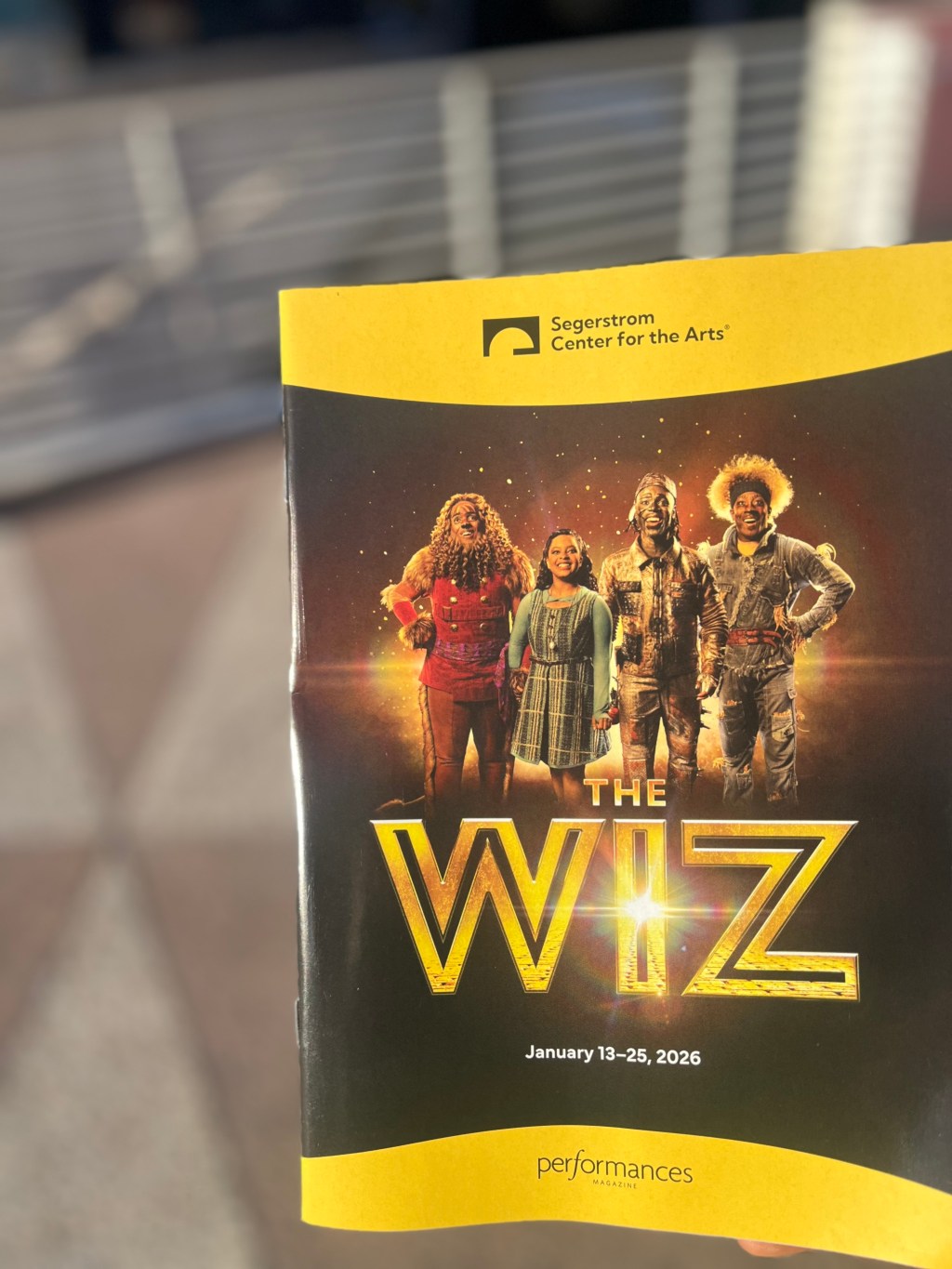
North American Tour / Segerstrom Center for the Arts
Director: Schele Williams
Choreographer: Jaquel Knight
Run Time: 2 Hours and 10 Minutes (+ 20 Minute Intermission)
Review by Destiny Lynn
A Contemporary Twist on a Classic Tale
This touring revival of The Wiz preserved the familiar narrative of The Wizard of Oz while recentering the story within Black cultural expression. The production did not pursue radical reinvention in the manner of Hamilton; instead, it refreshed the tone and texture through funk-inflected orchestrations, bass-forward grooves, and design choices rooted in Black theatrical traditions.
The result was a staging that foregrounds themes of self-determination and collective pride without disrupting the original story’s moral clarity. Oz remained a place of fantasy, but framed it as a cultural space shaped by communal resilience rather than whimsical spectacle alone.
Ease on Down the New Yellow Brick Road
Director Schele Williams introduced measured conceptual departures, most notably delaying the visual presence of the Yellow Brick Road until Dorothy arrived in Oz and replaced the ruby slippers with silver boots. These choices subtly reframed the journey as one of gradual recognition rather than immediate promise, allowing the destination to emerge through experience rather than iconography.
The cast, uniformly strong in vocal execution, sustained the production’s musical authority throughout. Dramatically, the evening was more uneven.
Dana Cimone’s Dorothy initially suggested a fresh interpretive direction by opting for a restless, slightly defiant adolescent whose edges felt contemporary. Yet as the narrative progressed, the performance retreated into a more familiar, Garland-adjacent vulnerability. The vocalism remains assured, but the emotional arc lacked accumulation, leaving Dorothy’s transformation underarticulated.
Kyla Jade offered a study in contrast as both Aunt Em and Evilene. Her Aunt Em was grounded and protective, radiating domestic steadiness, while her Evilene carried theatrical sharpness without lapsing into caricature. The dual performance underscored the production’s interest in emotional polarity: safety and threat, home and exile.
Meanwhile, Elijah Ahmad Lewis’s Scarecrow and Alan Mingo Jr.’s Wiz emerged as the evening’s most consistently compelling presence. Lewis’s physical comedy was calibrated rather than broad, his musical phrasing fluid, and his movement phrasing among the production’s most rhythmically assured. The character’s comic intelligence registered as intentional rather than incidental. As the original Wiz, Alan Mingo Jr. reimagined the figure not as a mystical enigma but as a consummate showman. His performance radiated confidence, charisma, and theatrical illusion. It was a reading that aligns closely with the role’s thematic undercurrent: power as projection.
Soulful Sounds with Groovy Choreography
Musically, the production favored cohesion over standout moments. Individual numbers rarely demanded singular attention, but the cumulative effect of the score, rooted in funk rhythms and ensemble-driven momentum, created a unified sonic landscape. The musical language functioned as an atmosphere of expression that reinforced the world of Oz as culturally textured rather than merely decorative.
The visual design drew from a range of referents. The Cowardly Lion’s makeup evoked the stylized theatrical lineage of The Lion King, while the Tin Man’s costuming gestured toward 1990s urban aesthetics, situating fantasy within recognizable cultural vernaculars.
Jaquel Knight’s choreography blended ballet and tap with funk-inflected groove, emphasizing rhythmic clarity and ensemble cohesion. Yet the movement language, particularly in the group travel sequences, sometimes read as mechanically precise rather than organically expressive. The iconic journey down the Yellow Brick Road became less a fluid progression than a series of carefully executed patterns, trading narrative ease for technical order.
There’s No Place Like Home
This Wiz concluded as expected, reaffirming home not as a fixed geography but as an earned sense of belonging. The production’s strengths lie in its vocal command, cultural framing, and select performances of notable specificity. Its limitations surfaced in moments where character development yielded to familiarity and movement yielded to structure.
Rather than radically revising its source, this revival consolidates it by asserting The Wiz as a cultural artifact that continues to speak through its sound, its performers, and its insistence that self-recognition, not magic, propels the journey home.
Destiny Lynn is a writer and reviewer with a passion for exploring the intersection of history, identity, and storytelling through musical theatre and novels adapted to screen.
 Book-in-Motion