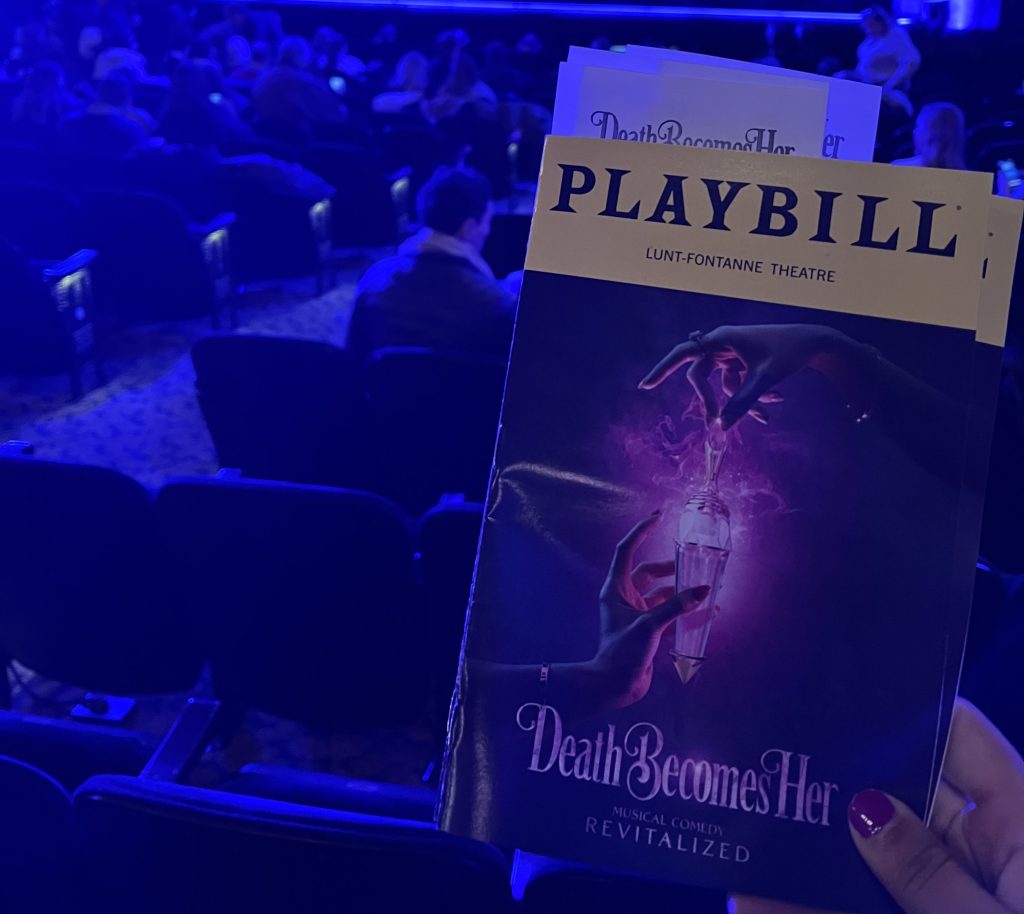
Universal Theatrical Group / Lunt-Fontanne Theatre
Director: Ben Cohn
Music & Lyrics: Julia Mattison & Noel Carey
Run Time: 2 Hours and 5 Minutes (plus 15-Minute Intermission)
Review by Destiny Lynn
That Was Then, This is Now
How far are you willing to go for perfection?
Robert Zemeckis’ 1992 film starring Meryl Streep, Goldie Hawn, and Bruce Willis introduced that question through glossy satire and award-winning visual effects. This Broadway adaptation at the Lunt-Fontanne Theatre under Director Ben Cohn expanded the concept into a Tony-winning musical that traded cinematic illusion for more laughter, more glamour, and a design vocabulary built to dazzle. The result was not just a remake, but a heightened reinvention of a cultural cautionary tale. One answer is clear: audiences can understand and enjoy the musical without having seen the movie.
The musical retained the original story by witnessing the friendship turned rivalry between Madeline Ashton and Helen Sharp. These two women were bonded by envy, betrayal, and an increasing desire for lasting beauty and prestige. Madeline, the diamond of her time, used to getting her way, seduced Dr. Ernest Menville away from her former best friend, Helen. This outlined the foundation for the story, where each scene was fueled by vanity and resentment over their feud. Their shared solution? A potion that promised eternal youth. The caveat? Beauty was only preserved as long as the body remained intact. Between a twisted neck and a hole in the midsection revealed for lasting laughs, Death Becomes Her framed perfection as a cosmetic illusion. Beauty was the currency, but was time really the enemy?
If You Want Perfection, Then Take a Look at the Cast
The original cast has largely remained intact since the show’s November 2024 Broadway debut, and that continuity showed in the polish of the ensemble.
Jennifer Simard as Helen Sharp was a study in comedic precision and emotional timing. She navigated Helen’s transformation from runner-up to rival with a finely tuned sense of rhythm by allowing self-deprecation to boil into fury without losing the audience’s sympathy. Simard’s performance was comical but also structurally cohesive by marking each emotional pivot with clarity.
Alongside Simard was her long-standing companion in Broadway, Christopher Sieber as Dr. Ernest Menville. Sieber anchored the production with a grounded, yet comedic, presence that became its most human throughline. In numbers such as “Til Death” and “The Plan,” Sieber leaned into the character’s anxious ordinariness by offering a counterweight to the surrounding theatrical excess. His Ernest was hilarious but very recognizable as a man outpaced by the very fantasy he married into. The talking furniture and supplies next to him? Well, perhaps that was the alcohol singing.
Betsy Wolfe, in her second week stepping into the role of Madeline Ashton after Megan Hilty’s departure, faced the difficult task of inheriting a star’s impact. Wolfe met the role’s athletic demands vocally and physically with impressive control, particularly in “For the Gaze” and “Falling Apart.” These songs required operatic range on the one end and rapid-fire singing on the other. Her Madeline was vocally thrilling and physically committed, especially through the numerous quick costume changes that happened on and off stage. She also excelled in portraying voices and different characters for quick comedic gags. However, she is still finding her emotional dimension in the role. Where Hilty’s Madeline leaned into the terror of aging beneath the bravado and landed her comedic lines more naturally, Wolfe’s version remained a more aloof and youthful shell not yet cracked. That said, for a role that is still new to her, Wolfe left a distinct imprint rather than a carbon copy.
With Michelle Williams absent from this performance, understudy Ximone Rose stepped in as Viola Van Horn, the core architect of eternal beauty. Rose offered a grounded, commanding presence that reframed Viola less as a spectacle and more as a strategist. While Williams brought vocal authority in the original soundtrack, Rose provided narrative clarity by rooting the character’s mystique in intention rather than just allure.
As a result, time on the stage together has allowed this cast to develop a strong working relationship in knowing how to time their dialogue and singing for a stronger impact without surpassing each other.
Keeping Score! The Musical Impact Behind the Show’s Success
Music and lyricists Julia Mattison and Noel Carey honored the tonal spirit of the original 1992 film while emphasizing theatrical storytelling. The music carried the narrative forward with rhythmic momentum, often functioning as character exploration rather than a decorative pause. The score largely stood on its own, though there were moments, particularly leading into Helen’s “That Was Then, This is Now,” where additional spoken dialogue might have transitioned the scene smoother.
Still, the craftsmanship was undeniable and rare to experience an album that could seamlessly move from one song to the next. The score moved with confidence from the immediate hook of “If You Want Perfection” to the climatic sweep of “Alive Forever.” Mattison and Carey understood how melodies could reveal power shifts, rivalry, and delusion through different music structures. Their compositional ambition recalled the narrative density of Sondheim and the emotional sweep of Rodger and Hammerstein. As a short preview, I encourage you to listen to their Tiny Desk concert.
Designs For the Gaze
Alongside the acting and musical storytelling, the design team embraced the glamour for a theatrical impact. Scenic designer Derek McLane’s oversized staircase, central to the show’s iconic fall, became both a spectacle and metaphor. It was a literal elevation from which the characters inevitably tumbled. The set’s fluid transformations from Madeline’s home to backstage dressing room to Viola’s lair supported the show’s obsession with transformations.
Paul Tazewell’s costumes shimmered with elegance that echoed the fantasy of eternal beauty through beaded glamour and hyper-saturated color. The choreography of the quick changes, especially in “For the Gaze,” was evidence of theatrical labor disguised as effortlessness. Wolfe alone underwent six rapid transformations, hair included, reinforcing the show’s central irony: perfection takes work, and lots of it.
Finally, the effects maintained narrative clarity through technical precision to externalize the violent consequences rivaries could take to preserve the illusion of beauty and perfection: gravity-defying tumbles, twisted necks, and arrows through the stomach.
The Cost of Perfection?
At it core, Death Becomes Her was a story about aesthetic obsession in a culture that treats youth as a moral virtue. Viola Van Horn and her ageless ensemble boasted their beauty and perfection at the cost of permanently removing themselves from society after a brief ten years. However, Dr. Ernest’s marriage to Madeline quickly collapsed under the realization that beauty along could not sustain intimacy. And both Madeline and Helen discovered that the pursuit of beauty corroded the very the relationships meant to validate it.
What emerged, therefore, was a satire that understood spectacles as both seductive and a warning. The musical did not reject glamour. Instead, it emphasized that perfection was a theatrical scene that dazzled from a distance but was brutal up close.
Alive Forever (National Tour 2026)
Nominated for 10 Tony Awards in 2025, including Best Musical, performance, score, and design, Death Becomes Her will extend its afterlife with a national tour beginning in fall 2026. The Broadway production offers a glossy, self-aware story that balances comedy with authenticity. Fans of musicals that interrogate vanity through humor will find plenty to savor. Watching the original film adds context, but the musical stands confidently on its own.
Destiny Lynn is a writer and reviewer with a passion for exploring the intersection of history, identity, and storytelling through musical theatre and novels adapted to screen.
 Book-in-Motion