
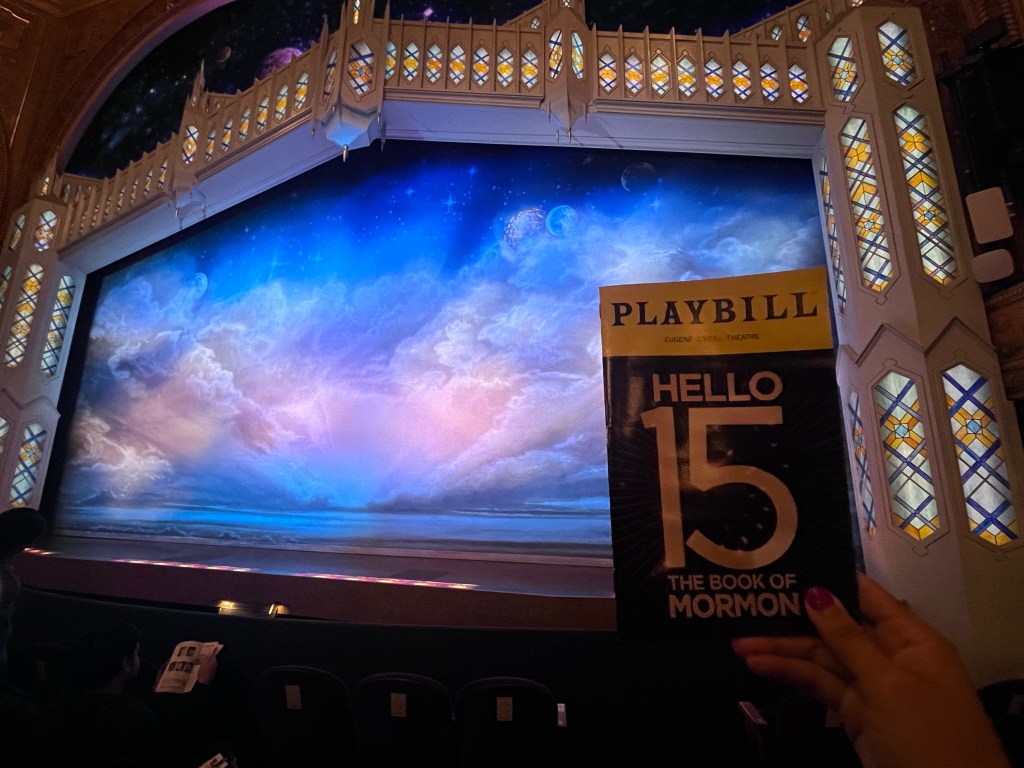
Universal Theatrical Group / Eugene O’Neill Theatre
Director: Casey Nicholaw, Trey Parker
Playwright & Lyricist: Robert Lopez, Trey Parker, Matt Stone
Run Time: 2 Hours and 15 Minutes (plus 15-Minute Intermission)
Review by Destiny Lynn
Hello! This is a Short Synopsis
What is the next best thing that comes to mind when you think of Matt Stone and Trey Parker besides the creators of South Park? A musical satire, of course! In this nine-time Tony Award-winning musical, the Book of Mormon continues its 15th year at the Eugene O’Neill Theatre, proving that satire still has a home on Broadway.
Meet Elder Price, the golden boy of his missionary class, determined to convert the masses to the Mormon faith. Then there was Elder Cunningham, his comedic foil, who was simply trying not to disappoint his father. When the unlikely pair are assigned to serve in Uganda, their expectations of missionary life are immediately challenged by cultural differences. “Oh, like Lion King!” was all Elder Cunningham envisioned for Africa. Through humor that often divided audiences, The Book of Mormon ultimately explored the consequences of expectations and what happened when reality refused to match the script.
Missionaries in Motion
As a mixture of seasoned performers and those making their debut, the leads notably carried the production with confidence.
Kevin Clay (Elder Price) embodied the role with polished ambition and a natural energy for the audience. In Act I, Clay portrayed confidence and ego, believing that his character’s religious teachings would change the world. While extending well into Act II, Clay slowly unraveled to his breaking point rather than a sudden breakdown.
Diego Enrico (Elder Cunningham) served as the necessary counterbalance to Kevin Clay. His comedy extended beyond cheap punchlines; instead, it lived through his movement, vocal choices, and timing in conversations. Especially in “Making Things Up Again,” Enrico embraced the chaos of Cunningham’s imagination with spontaneity, allowing the scene to feel fresh rather than rehearsed. By the end, it was challenging not to root for him.
Sydney Quildon (Nabulungi) rounded out the performance with sincerity. As a Ugandan villager intrigued by the Mormon faith, she emphasized a shared humanity between the cultures. Vocally, she delivered a strong and controlled performance, particularly in “Sal Tlay Ka Siti,” or Salt Lake City. She sustained her song in a reprise within the song “Man Up” that brought her and Enrico on competing edges of the stage. The notes cut cleanly through orchestrations for a powerful, emotional close of Act I.
Acts Balanced Two by Two
With numerous dance breaks as a nod to classic Broadway performances, Directors Casey Nicholaw and Trey Parker maintained clear pacing between Acts I and II. The opening number, “Hello!,” immediately established the tone as the cast mimed doorbell rings in staggered rhythm. Despite the simple staging, it was visually effective. The story then immediately contrasted Elder Price and Elder Cunningham that led to a confident intermission break as both reached their breaking points. By Act II, the story shifted towards consequence, revealing the impact of their actions on themselves and the Ugandan community. While some transitions, particularly the hospital scene involving Elder Price, felt abrupt, the narrative remained largely cohesive.
Paradise, Perception, and Pink Vests
For a long-running Broadway production, the set design prioritized function over dazzle. The main backdrop, in the beginning and after intermission, visually reinforced the idea of religious paradise. With a few props here and there for the scenes in Uganda, the stage remained largely open for characters to casually enter and exit. This allowed the focus on the choreography and character interaction, where the comedy was emphasized.
However, the costuming effectively reflected cultural stereotypes, some exaggerated, but instantly recognizable. Most recognizable was the attire that reflected the Mormon missionaries, where they wore their classic white button-up shirts, ties, and black slacks. In contrast, the Ugandan villagers’ costumes initially reflected exaggerated stereotypes, a deliberate choice from designer Ann Roth to reflect the missionaries’ limited worldview. As the story progressed, the exaggeration softened, visually mirroring the characters’ growing awareness. One of the most memorable visual moments occurred during “Turn it Off,” when a tap sequence from the missionaries resulted in quick stage blackouts to reveal sparkling pink vests. As such, this was a playful nod to what Broadway was about.
Making Themes Up Again
While Trey Parker and Matt Stone are known for pushing boundaries, i.e., South Park, the satire here revealed the consequences of expectations within their appreciation for Broadway. Strip away the explicit humor, and you can see how the story centered on the outcomes, not necessarily religious outcomes. Elder Price believed effort guaranteed success, as demonstrated by taking his mission seriously to convert as many people to the Mormon faith. Elder Cunningham believed imagination built a community by helping the Ugandan villagers understand The Book of Mormon without actually having read it. Neither was entirely right nor entirely wrong.
While rooted in a religious tale, the story did not aim to mock or educate audiences about Mormonism. Instead, it examined what happened when people clung to expectations in unfamiliar environments. Yes, certain portrayals of Uganda were outdated, but the discomfort partly explains why it remained successful 15 years later. Beneath the shock was a story about how fragile certainty and expectations can be.
HELLO 15!
After 15 years on Broadway, The Book of Mormon remains among the longest-running contemporary musicals, a rare accomplishment. Listening to the soundtrack first reveals an accurate depiction of the humor and language involved in the show that is certainly not for everyone. It is very plausible to witness your neighbor tearing up from laughter on one side, while the other is horror-stricken in silence. That tension is part of the show’s identity. If you enjoyed Avenue Q!, The Book of Mormon serves as a strong compliment. If you do attend a performance, you may recognize more than a few Broadway parodies intertwined throughout.
Fifteen years later, the doorbell still rings, on Broadway and on the US National Tour.
Destiny Lynn is a writer and reviewer with a passion for exploring the intersection of history, identity, and storytelling through musical theatre and screen adaptations of novels.
 Book-in-Motion