
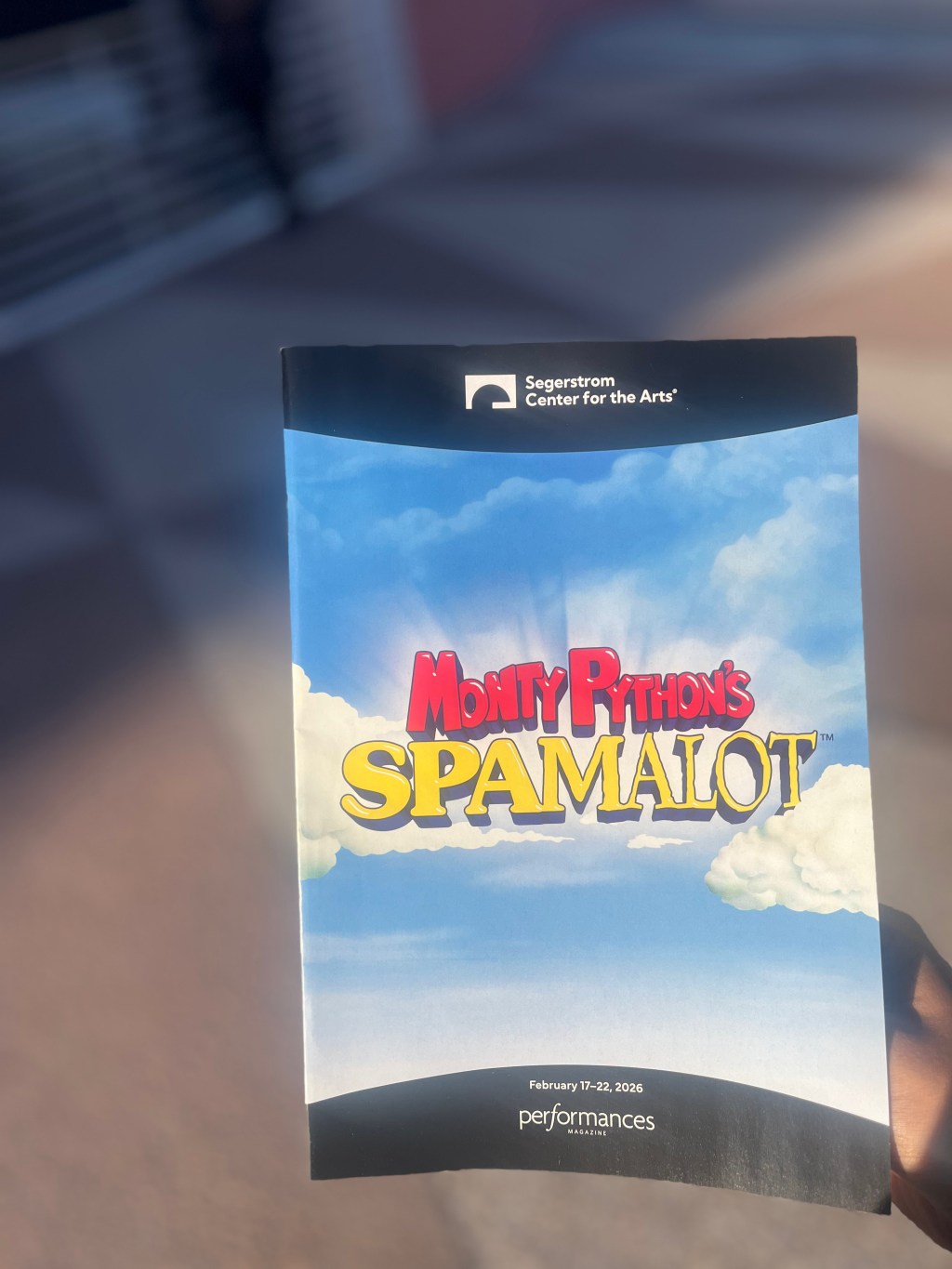
North American Tour / Segerstrom Center for the Arts
Director & Choreographer: Josh Rhodes
Run Time: 2 Hours and 15 Minutes (+ 20 Minute Intermission)
Review by Destiny Lynn
A Historian’s Introduction
This. That. “‘Tis but a scratch,” and a whole lot of Spam on the quest for the Holy Grail. Absurdity reigned supreme in Monty Python’s Spamalot presented at the Segerstrom Center for the Arts and directed and choreographed by Josh Rhodes. This North American tour embraced British satire while translating its humor and fantasy for American audiences. Beneath the comedy revealed a familiar question: what gave life meaning: glory, purpose, or connection?
Introducing King Arthur and his knights on their quest to locate the Holy Grail, he recruited knights and villagers from around the world. In came Sir Lancelot, Sir Robin, Sir Galahad, and Sir Bedevere to represent the legendary round table. Along the way, they encountered detours, theatrical spectacles, and self-discovery. While the narrative playfully mocks medieval legends, the production ultimately celebrated identity, community, and the love of theatre itself. Mix satire with history and theatre; what could go wrong?
A Round Table of Performances
Major Attaway as King Arthur served as the production’s grounded authority who asserted his power in a traditional fashion. Amid the circumstances on stage, delivered realism in his character by balancing authority and sincerity. Attaway portrayed a ruler attempting to maintain dignity while surrounded by delightful nonsense. His performance grounded the comedy while allowing the absurd moments to land more effectively.
Chris Collins-Pisano’s Sir Lancelot offered one of the evening’s most entertaining character arcs. Initially presented as a hyper-masculine knight on a heroic rescue mission, Collins-Pisano gradually revealed a different identity wrapped in bedazzled armor in strobe-infused dance sequences. was certainly your modern knight, who flashed his bedazzled armor in a strobe-infused dance sequence.
As Patsy, Blake Segal, demonstrated remarkable physical and comedic precision. As King Arthur’s servant, Segal was tasked with creating the illusion of a galloping horse using the infamous coconuts remembered from the film. From quick-patted trots to long-extended leaps, Segal’s timing and spatial awareness was essential to maintaining the comedic rhythm. As a comedic effect, his role extended beyond servant to confidence, particularly during “I’m All Alone,” where the humor emerged from Arthur’s oblivious loneliness despite Patsy standing faithfully beside him. Though, a few mess-ups may have blended well for a show like this.
Detours Along the Quest
Including a character to play the Historian referenced earlier theatrical traditions, where narrators guided audiences through complex stories. Here, the Historian not only established context but also become part of the comedy, parodying overly serious storytelling conventions.
While the structure mirrored the original comedic style from the film, several extended musical and improvised moments slightly slowed the pacing. Tighter transitions may have sharpened audience laughter by sustaining comedic moments rather an allowing energy to linger within scenes.
Physical and Projected Sets
With more productions using projections and video walls as their scenic designs, this production demonstrated how modern staging technology could enhance rather than replace traditional designs. Projected landscapes such as drifting clouds and moving trees layered effectively with physical set pieces, creating depth as performers navigated the stage. Particularly memorable was the animated projection of God, whose zooming presence transformed a screen image into an animated feature appearing live as it spoke to King Arthur.
Lighting designs further shaped location and tone with vibrant colors supporting Broadway and Vegas-style dance numbers, while simplified lighting grounded quieter narrative moments. Even minimal set pieces, such as recurring doors, gained meaning through lighting shifts that signaled changing environments.
Keeping Score!
Good musical theatre reveals what story is told and how it is felt. Musically, this production embraced optimism even in moments of misfortune. Songs such as “Always Look on the Bright Side of Life” catered to the optimists and pessimists by balancing the benefits of life and death. As a philosophical reflection, the song encouraged audiences to confront life’s ambiguities and inevitable with humor. Similarly, “Not Dead Yet” transformed impending plague into a cheerful event, reinforcing the musical’s commitment to satire through humor and absurdity.
Finding The True Grail
King Arthur confidently tried living up to his status in life. As King of England, he traveled near and far to find the best talent because the King’s Court determined his future success. While recruiting people who did not entirely fit the qualifications, Sir Lancelot, Sir Robin, Sir Galahad, and Sir Bedevere revealed personal definitions of fulfillment. Even after asking God for a quest, who eventually provided the search for the Holy Grail, it was the Lady of the Lake who restored her promise to walk beside him. For King Arthur, love and marriage were his Holy Grail. Sir Lancelot found pride in his identity, while Sir Robin discovered his love of Broadway. As such, the grail was more than an object but an understanding that fulfillment was found through experiences rather than achievement. Even the Black Knight, humorous defeated but persistent, embodied the musical’s philosophy.
An Interactive Finale
Undoubtedly, audiences received Spamalot positively through a consistent, uproar of laughter. However, this production extended its energy beyond performance through a unique interactive experience. Lucky seat number A101 had the opportunity to join the cast after the Holy Grail was found under their seat for a photo opportunity. King Arthur and his knights also encouraged audiences to sing-along to “Always Look on the Bright Side of Life” with lyrics projected on the screen during the curtain call.
Ultimately, what made this show fun was the rewrites made to make the materials relevant for various ages. From Wicked, The Sound of Music, to Fiddler on the Roof, the show produced a satire of comedy and Broadway in general. Much tamer than The Book of Mormon and Avenue Q, fans of comedy, history, and Broadway will appreciate the nods to their favorite shows while enjoying silly comedy in the meantime.
Destiny Lynn is a writer and reviewer with a passion for exploring the intersection of history, identity, and storytelling through musical theatre and novels adapted to screen.
 Book-in-Motion