
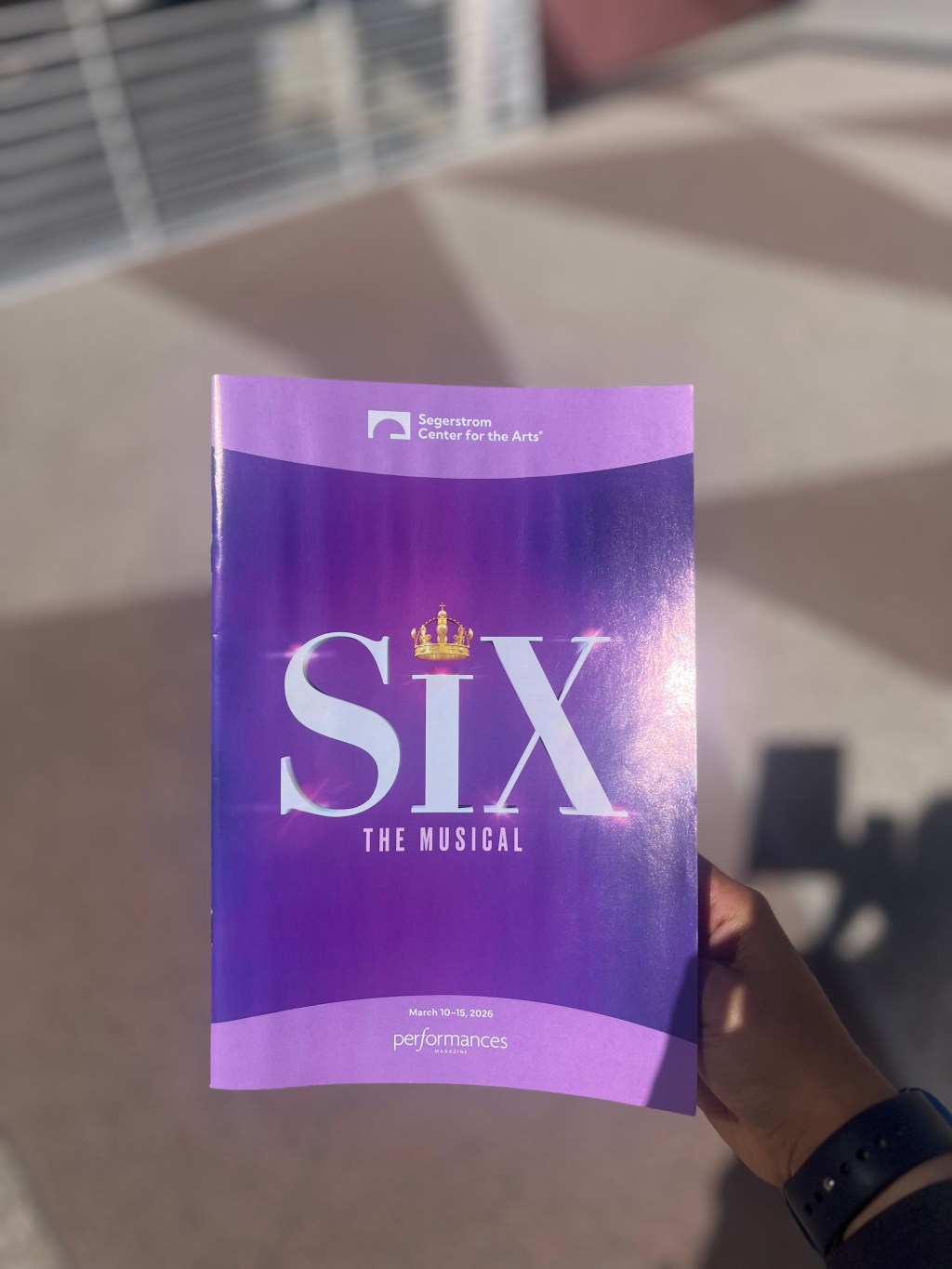
North American Tour / Segerstrom Center for the Arts
Directors: Lucy Moss & Jamie Armitage
Choreographer: Carrie-Anne Ingrouille
Run Time: 80 Minutes (No Intermission)
Review by Destiny Lynn
The Ex-Wives
What do Ariana Grande, Beyoncé, and Adele have in common? Everything to inspire a musical about the six wives of King Henry VIII from the 16th century, of course. “Divorced, Beheaded, Died…Divorced, Beheaded, Survived.” Women who faded into history made a thrilling return at Segerstrom Center for the Arts for an evening of singing, dancing, and competition. SIX, directed by Lucy Moss and Jamie Armitage, intertwined history and contemporary pop in the story of King Henry VIII’s wives. Rather than a traditional retelling, SIX immediately reframed Tudor history through a contemporary pop concert lens. Suited up in theatrical armor, the former queens prepared to compete over who experienced the worst fate. However, their competition eventually unraveled when they realized that winning did not change the fact that they were still reduced to a single page in history.
We’re SIX Leads: Divorce, Beheaded, Died, Survived
Introducing a small cast, the six ex-wives consisted of the following: Catherine of Aragon, Anne Boleyn, Jane Seymour, Anna of Cleves, Katherine Howard, and Catherine Parr. Unlike traditional musicals, the cast all served as the lead and supporting roles depending on their showcase song. Hailey Alexis Lewis (Anna of Cleves) and Nella Cole (Anne Boleyn), however, found a way to stand out as the strongest in performance. What felt forced in some dialogue and overly rehearsed in other numbers, Lewis delivered an authentic and comedic character in her portrayal of Anna of Cleves. The only member to experience a costume change on stage, Lewis revealed her vocal range in “Get Down” through controlled breathwork. As the sassiest in the show, Lewis successfully timed her interactions with the audience without uncomfortable silent gaps. Meanwhile, Nella Cole was the quirky, light-hearted Anne Boleyn who could spew lyrics quicker than anyone on stage. With a subtle, awkward lead-up to her showcase song in the competition, Cole demonstrated a consistent presence through song and dialogue.
Bedazzled Armor & Sets
As in many competitions, talent alone does not guarantee first place; attire and choreography rally support. In SIX, each wife was assigned a single-colored, bedazzled armor as a method to root for your favorite person, while separating the personalities. Whether the color choices carried symbolic meaning, the costumes served as the show’s defining visual identity. With a simple set that featured only risers for the band, the lighting coordinated with the color of the queen by reflecting off their costumes as they sang their solos. The minimalist staging, therefore, placed full emphasis on the performers, reinforcing a concert-like structure while allowing lighting to function as a storytelling device.
Concert or Musical?
A single-act performance with no intermission, the story quickly jumped from one queen’s life to the next in chronological order. As a music-driven performance with minimal dialogue, should SIX be classified as a concert or musical? The Ex-Wives certainly brought the energy and showstopping vocals alongside a live band on stage. Each number quickly led into the next one, with very brief introductions that spent more time explaining who the character was instead of developing the character. However, the costuming, lighting, and synchronized choreography elevated a standard concert through theatrical designs. Ultimately, SIX operated more effectively as a concert with theatrical elements than a traditional musical when exploring each queen.
Keeping Score!
Whether to consider SIX a concert or a musical, one thing remained: the music was the single driving piece of the story. Due to the lack of dialogue, the score succeeded in narrating the queen’s perspective of King Henry VIII. From the opening number that explained their fate, their individual numbers examined their lives before, during, and after King Henry VIII. Notable ones included “Don’t Lose Your Head” and “Get Down” for revealing the characters’ emotions through pop-inspired rhythm. Meanwhile, “Heart of Stone” and “I Don’t Need Your Love” allowed a slower, soulful pace in a quick transition performance. Though common to reveal multiple perspectives, it was challenging to situate the song in the story that did not offer time or dialogue to create depth and heartache in a character. Without sufficient dialogue to ground each perspective, some songs, “Heart of Stone,” feel emotionally unearned, making it harder for the audience to fully invest in each queen’s story.
A Her-Story Remix
Ultimately, SIX was not a retelling of history in trying to change their misfortunes. Instead, the performance made use of anachronistic dialogue and colorblind casting set to the tune of pop-driven rhythm. SIX thrived as a high-energy concert experience but fell short of the emotional depth expected of traditional musical theatre.
While sacrificing narrative depth for musical momentum, its energy, style, and performances made it a compelling and highly entertaining theatrical experience. Fans of Hamilton will appreciate contemporizing historical events to modern music and lyrics. Fans of Chicago will also enjoy the opening number that resembles the rhythm of “Cell Block Tango.” As a short show with minimal dialogue, audiences will exit singing about their favorite queen. Make sure to read the playbill for a brief Her-Story section on the actual queens and music inspirations.
Destiny Lynn is a writer and reviewer with a passion for exploring the intersection of history, identity, and storytelling through musical theatre and novels adapted to screen.
 Book-in-Motion