
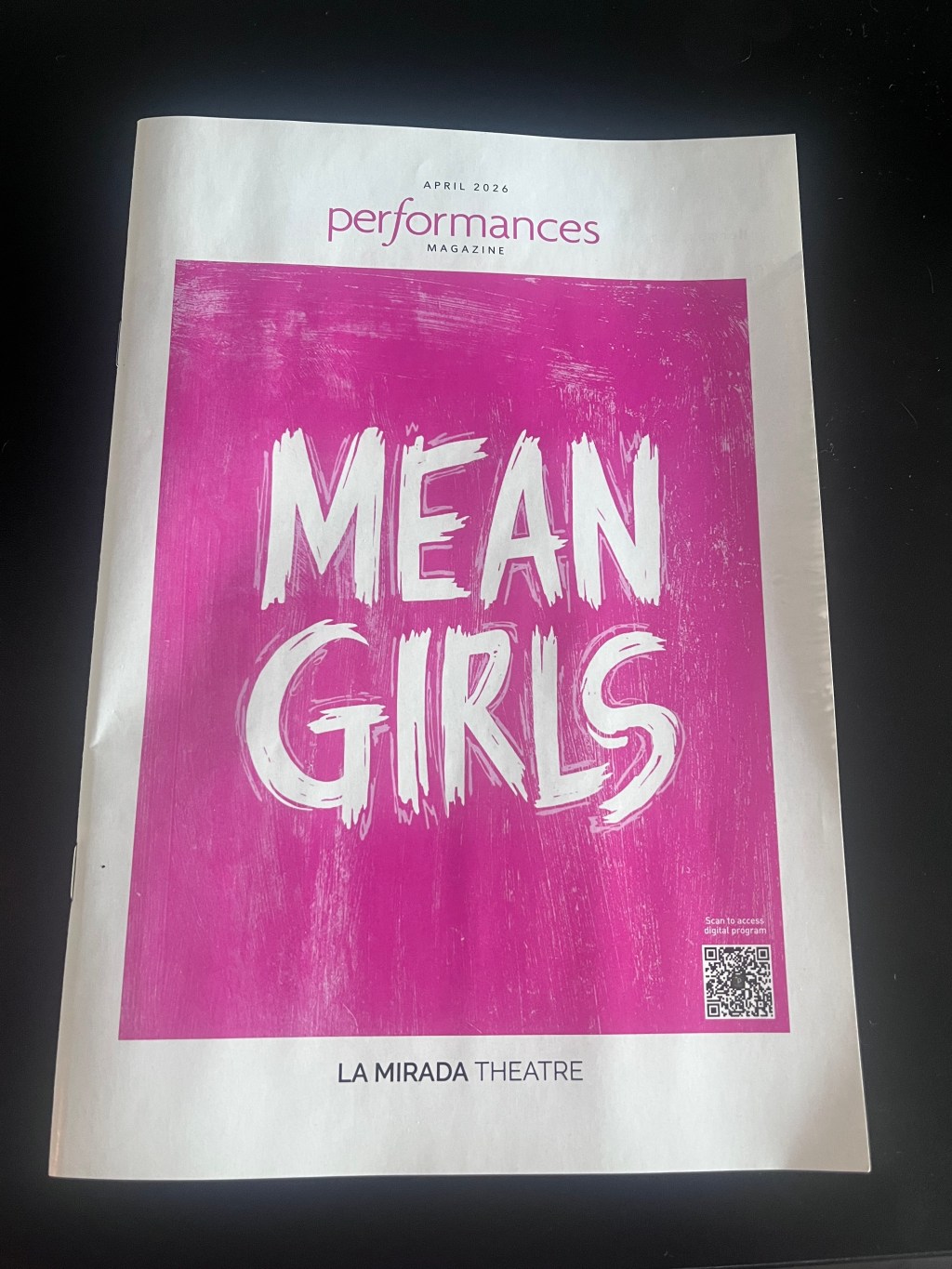
McCoy Rigby Entertainment / La Mirada Theatre
Director & Choreographer: Dana Solimando
Musical Director: Anthony Zediker
Run Time: 2 Hours, 15 Minutes (+ 15 Minute Intermission)
Review by Destiny Lynn
Welcome to North Shore High
“Get in, loser,” and settle in for a nostalgic, yet still relevant, cautionary tale about how a high school operates. Audiences eagerly anticipating the infamous “Burn Book” or waiting for “Fetch” to happen will find familiarity and a fresh perspective in Mean Girls: The Musical at La Mirada Theatre. Adapted from the 2004 film written by Tina Fey, the musical retained the original plot, while adding new features to make the story relevant under the direction of Dana Solimando.
Cady Heron returned to the United States after being homeschooled in Africa and entered high school as a sophomore, wanting to fit in. After meeting social outcasts Janis Sarkisian and Damien Hubbard, her world shifted when she entered The Plastics’ orbit, also known as Regina George, Gretchen Wieners, and Karen Smith. As the most powerful clique on campus, Cady Heron was quickly offered a seat at the table. However, one thing remained: there could only be one queen bee.
Yes, You Can Sit With Us
The production featured a strong cast, though the narrative extended well beyond Cady Heron as the singular lead. Katie Roche convincingly portrayed Cady’s evolution from a naive newcomer to a popular wannabe. However, she did not reach Regina George’s level of power. In a similar vein, Eric Myrick, as the heartthrob Aaron Samuels, approached the role in a tenderhearted, genuine character who appreciated Cady without the glamour. While adding warmth through this interpretation, it also created a slight disconnect, making his past relationship with Regina George less convincing.
Collectively known as The Plastics, Adrianna Rose Lyons (Regina George), Sarah-Anne Martinez (Gretchen Wieners), and Grace Fluharty (Karen Smith) retained the film’s persona while emphasizing distinct theatrical flair. As the most popular character in school, Lyons commanded the stage through styled intensity and strong vocals that anchored her dominance. As Regina’s loyal supporter, Martinez, as Gretchen Wieners, carefully crafted a role that slowly reached their breaking point. Meanwhile, Fluharty pushed deeper into Karen Smith’s lack of intelligence through voice and movement. Almost proud of her low IQ, Fluharty delivered numerous comedic moments in active dialogue and amplified moments of obliviousness.
While considered the social outcasts, McKenna Michael (Janis Sarkisian) and Gavin Leahy (Damien Hubbard) served as narrators and audience favorites as they guided Cady through high school cliques, albeit with some revenge sprinkled in. Michael brought an edgier interpretation to Janis in part from the costume team and attitude that proudly defied social norms. Musically talented vocally and instrumentally on the guitar, Michael made her anger shine through the reprise in “Someone Gets Hurt” after facing Cady’s betrayal. Leahy, as Damien Hubbard, was charismatic and confident in their character’s identity as he seamlessly sang his way through a school cafeteria or delivered dance breaks with the ensemble that made for an engaging performance.
For a minor character, Gwen Hollander was a triple threat in distinguishing Mrs. Heron, Ms. Norbury, and Mrs. George. Initially believed that they were performed by three different actresses, Hollander revealed her versatility as she brought significant energy and authenticity to each role. As a doppelganger to Tina Fey, Hollander revealed comedic precision and bravery to perform a trust fall amongst the ensemble in the middle of her dialogue. She even included awkward teacher dances to distinguish between the students and faculty. Equally powerful was her stark contrast as the “Cool Mom,” Mrs. George, whose solo added unexpected emotional depth beneath the flashy surface.
Watch the World Burn Through the “Burn Book”
With Act I lasting nearly 1 hour and 20 minutes, Dana Solimando’s direction effectively transitioned between scenes without losing momentum. Expanding Janis and Damien into narrators proved to be an effective choice to help guide the audience through Cady’s rapid immersion into North Shore High. By the time Cady, Janis, and Damien develop their revenge to take down the plastics, a few scenes after the “Revenge Party” number made for an ideal ending to Act I. Act II, however, lost some of that momentum. As the narrative shifted towards consequences and self-realization, the pacing slowed, and the transitions became less dynamic. However, the plot’s growing tension that resulted in Regina sharing the pages within the infamous “Burn Book” to the entire school drastically changed the energy that the audience expectantly awaited.
Mean Girls in a Social Media Era
But how does Mean Girls stay abreast with changes in communication? Traditional set pieces remained: classroom chairs, cafeteria tables, lockers, and bedrooms, which proved multifunctional in using them to communicate on campus and at home. Particularly interesting was the transition between different classes that required quick dexterity on the actors to shift between different quadrants and the lighting to spotlight the teacher or main character as they expressed their inner thoughts. There were moments where the audio was not quick enough to project which character was speaking.
However, modern technology from the large video wall introduced innovation and inconsistency. Projecting text messages, Instagram posts, and live-streams provided immediacy that younger audiences could relate to. These scenes accurately depicted how Mean Girls would look in today’s digital landscape in how fast communication and gossip can spread. Live streams were conducted in real time with everyone in the audience able to see through the video wall, with minor issues in not having the voice and movement in sync. For those familiar with the film, the iconic bus scene made its way into the performance through the video wall as it moved towards Regina George. It was surprising they did not switch out the actress for a human prop featured in other fight scenes to make the impact more dramatic. While displaying social media posts on the video wall of the aftermath, the point of contact between the actress and the video bus could have been tighter.
Keeping Score!
If Mean Girls revealed the story, the soundtrack presented the classic quotes through rock and pop inspirations. Opening with “Cautionary Tale,” Janis and Damien established the narrative’s tone before segueing into “It Roars,” where Cady was eager rather than apprehensive about entering high school, a contrast from the film. The story’s major quotable lines, including “That’s So Fetch,” were integrated into “Where Do You Belong” and “Meet the Plastics.” Meanwhile, “What’s Wrong With Me” and “Until Someone Gets Hurt” alongside their reprises added emotional depth across multiple characters that drew connections between Gretchen, Mrs. George, Regina, and Janis in unexpected ways.
The Limit Does Not Exist
For every Queen Bee, you have an army of worker bees until she dies or gets replaced. At its core, Mean Girls remains a story about power, identity, and the cost of conformity. Regina George was the “Queen Bee” with Gretchen Wieners and Karen Smith as the “Worker Bees,” or as author Rosalind Wiseman referred to as “Wannabes.” They fed information to Regina to maintain their high status, while classmates lifted the Queen Bee through fear or admiration. That is until Cady initially disrupts the social hierarchy, only to replicate the cycle. Ultimately, the show’s central message remains: popularity without authenticity is destructive.
The relevance behind the messages attributes its generational success to the help of notable quotes, finding its way into memes and TikToks. Mean Girls’ 2004 film is just as relevant as the 2017 Broadway debut, making the story a rite of passage for adolescents to watch. The excellence, however, emerged from genuine writing, crafted to the specific details.
This production succeeds most in its performances and its effort to modernize the story for a digital age. While technical inconsistencies and pacing issues in Act II prevent it from fully realizing its potential, the show remains engaging, relevant, and entertaining.

If you enjoyed Mean Girls, similar explorations of identity and social dynamics can be found in the movie or musical adaptation of Legally Blonde and Grease that reveal different levels of empowerment and cliques from high school and beyond. One would also be remiss if they excluded reading Rosalind Wiseman’s Queen Bees and Wannabes, from which the movie and musical were directly adapted, to understand the psychology behind these high school cliques and the lasting consequences into adulthood. Catch Mean Girls before it departs La Mirada Theatre on May 3rd.
Destiny Lynn is a writer and reviewer who explores the intersection of history, identity, and storytelling through musical theatre and novels adapted to stage and screen.

