
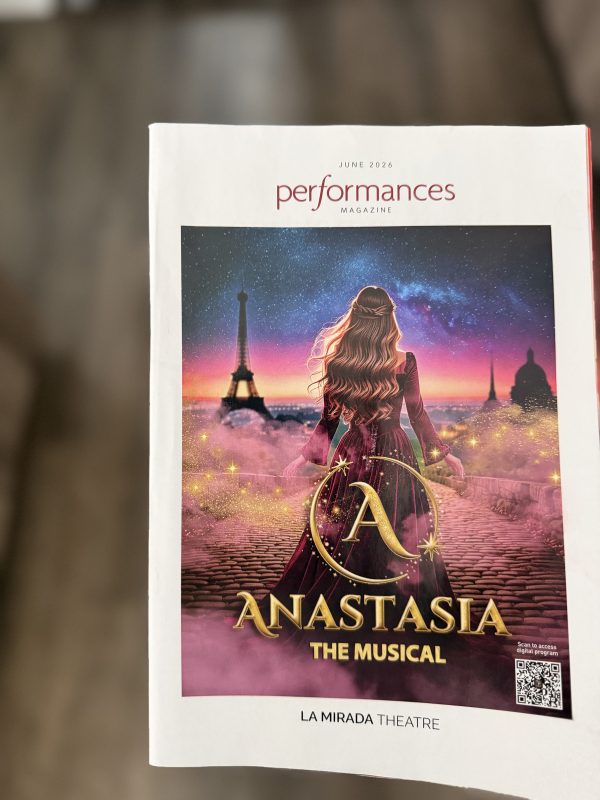
McCoy Rigby Entertainment / La Mirada Theatre
Director & Choreographer: Parker Esse
Run Time: 2 Hours, 15 Minutes (+ 15 Minute Intermission)
Review by Destiny Lynn
Introducing a Journey to Anastasia’s Past?
“A rumor, a legend, a mystery,” but one thing remains certain; La Mirada Theatre concludes their 25/26 season with Anastasia: The Broadway Musical in a nearly sold-out performance starring Lena Ceja, Dillon Klena, and Peyton Crim backed by a physically active ensemble.
The ruling Romanov family is murdered by an angry mob of Bolsheviks who want equality in Russia, leaving a grieving Dowager Empress Maria Feodorovna Romanov to mourn alone. However, traces and rumors of a possible surviving Anastasia prompts a generous reward for anyone who can find the missing granddaughter. Introducing Anya, the story follows a girl trying to remember who her family is after getting separated at a very early age. After meeting con-men Dmitry Sudayev and Vladimir Popov who notice Anya’s features resembling the missing Grand Duchess Anastasia Nikolaevna Romanov, they all travel to Paris to meet with the Dowager Empress. Motivated by financial rewards and connections with the royal court, Dmitry and Vladimir take their assignment seriously in dressing Anya up in manners, style, and family history until something unusual starts happening: she starts to remember stories that no one except the real Anastasia could know. Could Anya be the real Grand Duchess?
Under the direction of Parker Esse, this stage production slowly opens a music box of memories vastly different from the animated film towards a tenderhearted story with depth in character interactions, musicality, and choreography.
Strong Vocals, Even Stronger Dancing
Leading the production, Lena Ceja as Anya/Anastasia delivers a vulnerable role who could sustain vocal melodies. Whether solo in “Journey to the Past” or in harmony through “In a Crowd of Thousands,” Ceja maintains a consistent presence of vulnerability with moments of humor, particularly in the brief brawl scene where she is ready to tackle anyone in her presence.
Equally strong in presence included Dillon Klena (Dmitry) and Peyton Crim (Vladimir) who are less con-men and more strategic mentors. Klena brings urgency and heart into his role that at times make his motivations to ultimately trick Ceja into pretending to be Anastasia unbelievable as he was too sincere in the beginning. Undoubtedly taking the role seriously, the character feels almost too technical in transforming a character seeking selfish gains for one who becomes selfless. However, his strongest performance emerges in his heated interaction with Suzanna Guzman (Dowager Empress) in Act II, where that energy becomes an asset. As a comedic relief, Peyton Crim (Vladimir) in coordination with Sarah Wolter (Lily Malevsky-Malevitch) brought heavy audience reactions, particularly in Act II. Whether staged or improvised, Crim and Wolter generated enormous laughter in “The Countess and the Common Man” that made for a playful performance and mood change from anger, blood, and murder from Russia.
However, where the leading roles deliver strong vocals, the ensemble reveal athleticism in the choreography Parker Esse creates. Unlike theatrical dances that match the stage energy, the ensemble channels that energy through performing ballet and traditional Russian moves that require quick balance and precision. Anton Harrison LaMon notably demonstrates his talent in Act II’s “Land of Yesterday” in the Nova Club and final ballet scene, where his height and timing make a memorable impact.
Unequal Pacing from Russia to Paris
Broken into 2 acts, Act I in Russia and Act II in Paris, the direction was clear with slight problems with pacing, particularly with scene transitions. The opening number starts strong in creating a somber mood, where the audience experiences Russia’s transition from an empire to a communist state called Leningrad. Introducing the plot with murdering the Romanov royal family to ongoing political hunts from officers, there is an urgency to leave Russia. However, that necessity stalls when Gleb, a Bolshevik Officer, begins his search to see if the real Anastasia is alive. Where strong, authoritative performances from Richard Bermudez (Gleb) emerge that deepen the historical significance, introducing his scenes were choppy. However, a much appreciated look at the Eiffel Tower backdrop concluding “Journey to the Past” delivers a strong end to Act I.
Moving into a playful Act II in Paris, the mood drastically departs the somberness to comedic and tenderhearted scenes within the county’s decor. With a much quicker resolution, the two scenes that provide the most depth include Susanna Guzman’s realization that her granddaughter is alive and when Anastasia is nearly murdered a second time. As the most heightened scenes in the performance, both offer a mood of redemption and realization. It also helps to add that the performance creates a unique twist in the end.
Vibrant Set to Match the Tone of Russia and Paris
As a veteran in utilizing video walls into their productions, Aaron Rhyne and the projection design team cleverly intertwines physical sets with video sets to create an almost cinematic experience. Starting with the opening red explosion and the “1917” digital lettering that slowly emerges on the pillars, the set establishes the plot and setting. Aside from merely decorated backdrops of snow or the Pont des Arts bridge in Paris, La Mirada Theatre elevates the stage by synchronising the train with the video wall to visually simulate a moving train from different angles. Finally, the dancing ghosts in the background of Anya’s room as she sings “Once Upon a December” fills the stage with unspoken performers and ultimately elevates a standard performance.
Where Does Family Belong?
At its core, Anastasia: The Broadway Musical examines an alternate history of what happened to the Romanov family. Through Anastasia’s exploration to discover who her family is and seeing how both sides of society live, she finds a new purpose in a life outside the palace walls. What is the best form of love? One that does not take. Forgoing the money and memorabilia, the memories within the people transcended Anastasia, Dmitry, Vladimir, Gleb, and the redeemed Dowager Empress Maria.
Ultimately, Parker Esse’s Anastasia could be summed up in two words: energetically vulnerable. A major detour from the animated film with darker themes behind the historical anger the Bolsheviks had toward the royal family, the score’s placement made better sense when presented on stage. Hence, the stage production would be suitable for adolescents onward. Fans of history and similar interests in identity would enjoy Les Miserables, Come From Away, and the Sound of Music for its tonality and authenticity.
“Was she the real Anastasia? Well, she was my favorite.” – Dowager Empress Maria
Destiny Lynn is a writer and reviewer with a passion for exploring the intersection of history, identity, and storytelling through musical theatre and novels adapted to screen.

